


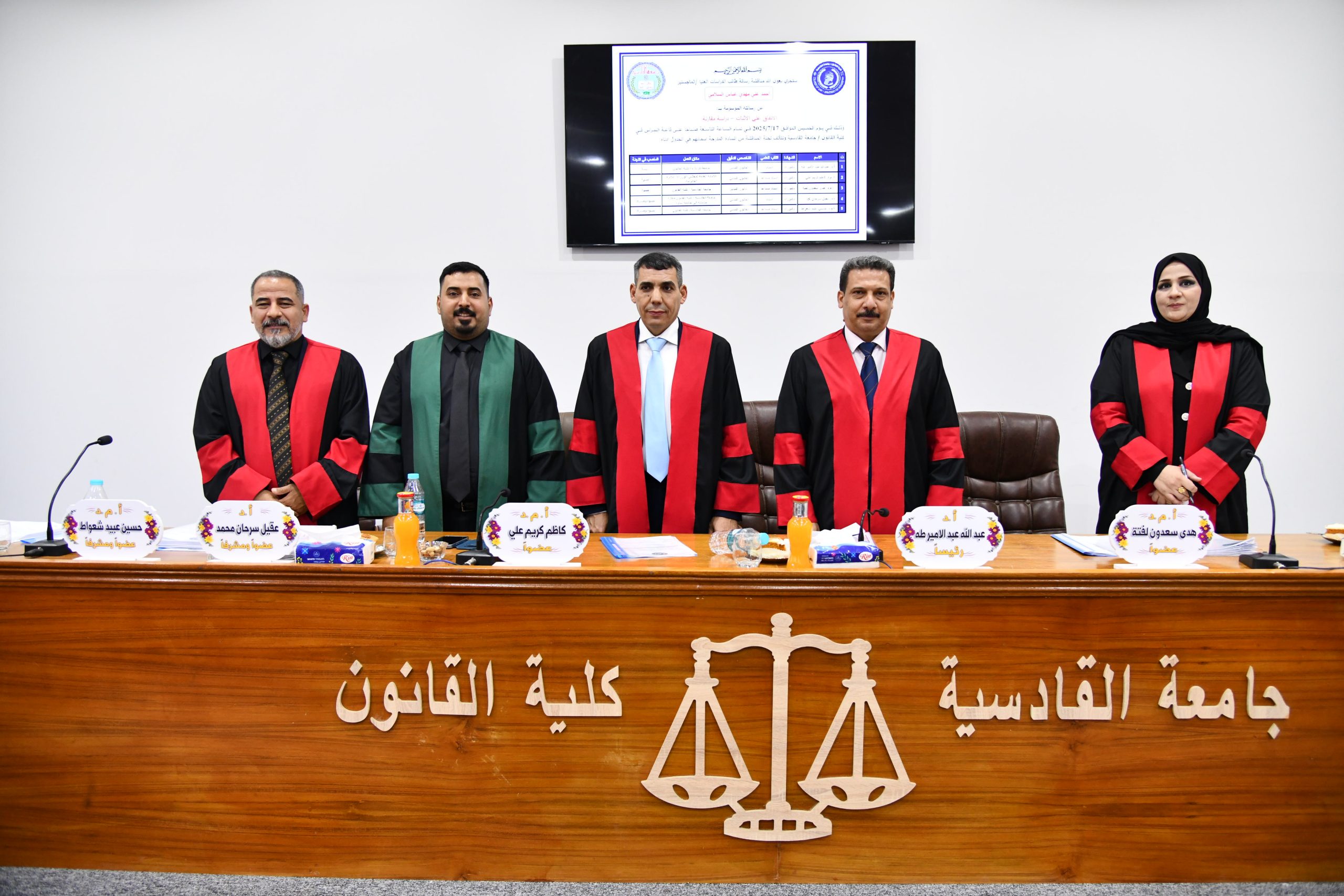
A master’s thesis entitled “Agreement on Evidence – A Comparative Study” was discussed at the College of Law, University of Al-Qadisiyah, by the researcher Ahmed Ali Mahdi.
The thesis aimed to reinforce the principle of contractual will, where agreement on evidentiary procedures reflects the parties’ freedom to organize their legal rights and processes. This, in turn, strengthens the doctrine of autonomy of will, especially in civil and commercial relationships. Furthermore, agreeing on a specific method of proof can reduce procedural disputes by minimizing disagreements over evidentiary tools before the court, thereby making the case clearer and aiding the judge in reaching a decision more efficiently.
The thesis concluded that the foundation of agreement on evidence lies in the parties’ autonomous will, which allows them to define the rules and methods of proof they wish to adopt for resolving their dispute. Alternatively, the basis may be found in evidentiary law, which classifies rules into those related to public order and others, allowing the parties to agree on exceptions and specify the acceptable form of proof.
The study recommended that the Iraqi legislator amend Article (77) of the Evidence Law by adding a paragraph stating:
“The parties may, by written agreement, determine specific methods for evidence, or agree to waive it in whole or in part, or exclude a particular means of proof, whether before or during the dispute, provided that the agreement does not contravene public order provisions or impair the rights of defense.”
The examination committee consisted of the following members:
- Prof. Dr. Abdullah Abdul-Amir Taha – Chair
- Asst. Prof. Dr. Kadhem Kareem Ali – Member
- Asst. Prof. Dr. Huda Saadoun Lata – Member
- Prof. Dr. Aqeel Sarhan Mohammed – Member and Supervisor
- Asst. Prof. Dr. Hussein Obaid Shawat – Member and Supervisor



لا تعليق